
| In support of my webspace rental fees pllease donate generously at Patreon |
Thank
your for visiting. If you enjoy this site please make a donation. |
|
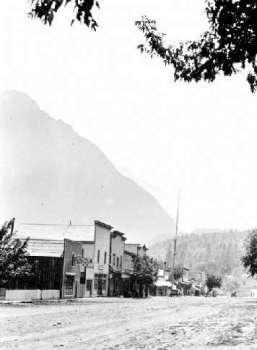 BC Archives # H-01006 1914 The Golden Mile had the look and feel of a genuine Wild West town's Main Street, which indeed it was, even though this far-flung bit of the Wild West was in British (or at the time of this picture, Canadian) territory, instead of Colorado or Arizona. In fact, during the earliest years of the 1858 Gold Rush, this was the American West - and might have wound up in the history books that way if not for Governor Douglas and Judge Begbie! Respect among the territory's predominant Americans for these two founders of British authority on the mainland helped avert BC from being declared the state of "Jefferson". The falsefront style architecture shown here, lining the main commercial block of Main Street, is as typical of the Canadian West as it is of the American West, though, even in areas where Americans did not predominate as they did in Lillooet (see below). The third of the taller buildings shown here, the one with the peaked gable, was Phair's store, a Lillooet institution about which there'll be a whole webpage here one day, plus a biography of its main storekeeper, Artie Phair, whose several decades of photographs form the main collection of historic images of Lillooet today. It was pretty quiet in the 1910s, as suggested by the empty street here, although this looks to be taken in the heat of mid-day so smart Lilloooeters are probably hanging out in the shade, or are out at Seton Beach, as always. A year later, the PGE railway would open, connecting Lillooet to the Coast via Newport (what is now Squamish) - some said "from nowhere to nowhere" - but it did spur local business once again, providing an outlet for Lillooet's market produce and beef and other exports, including commercial ice. |
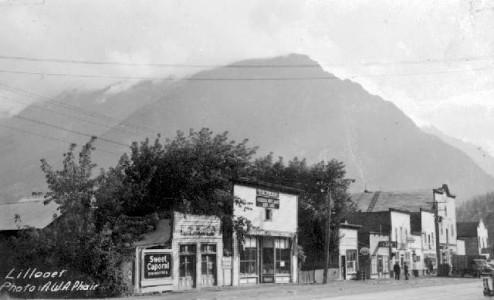 BC Archives # C-01246 1930s The picture at left is from the 1930s, and as you can see it loooks pretty much like it did in 1914 (just above), although a couple of larger store buildings are gone, evidently destroyed by fire in the meantime. Lillooet still looked pretty much like this in the 1950s (pic below) and still again in mid-1970s when I came back for the first time as an adult. By the mid-1980s, however, nearly all 19th Century buildings were gone in the years since, though, and around 1979 or so Main Street was finally paved for the first time and the hitching posts for horses were removed. Canyons, sagebrush, desert. goldrush boomtowns, cowboys, Indians, western-style falsefronts with hitching posts outside the saloons and drygoods stores and saddleries - this was Lillooet and in a lot of ways still is. The imagery of the American West is hard to shake in Lillooet. Frontier-era Lillooet owed much of its American flavour to the numerous Americans who thronged northwards in search of gold and adventure, even in the mid-20th Century. Because of the predominance of Americans as a group in gold rush Lillooet and the Fraser Canyon, "Boston" in the local variant of Chinook Jargon could simply mean "white", as opposed to specifically "American", as it did in other areas. "American" was something of an "ethnic" identity in Interior BC in the old days, distinct from the various kinds of British and Europeans. Many Cariboo, Canyon, and Okanagan families still have "American" roots from the earliest frontier times. Lillooet's most famous expat American, of course, was Margaret Lally "Ma" Murray. although she was a latecomer by comparison to the goldrush-era American pioneers, many of whom were still alive when Ma settled into Lillooet and founded the Bridge River-Lillooet News. |
 Photo: Artie Phair Postcard |
This is a 1950s-vintage photo of Lillooet's tiny old movie theatre, now nondescript in beige stucco but at one time famous and still notable as the actual camel barn of pioneer Frank Laumeister's experiment in using camels in BC's dry interior. The building is one of the oldest standing in Lillooet, despite its drab modern finish (grey stucco). Some say you can still smell the camels, but I always thought that was due to decades of decaying popcorn and who-knows-what-else. The building is very small inside, and if I recall right it was barely eight seats wide and ten rows deep, if that. It's been a dry-cleaners and a thrift store since its decommissioning as a cinema, and last time I was in ton was up for sale. Anyone got some camels and need a good barn? |
 Photo: Perry Cleven |
There's
not much different about this second picture, except for my Dad standing
in front of it; my guess is that's a copy of the Bridge
River-Lillooet News he's holding. Dad was a big fan of
Lillooet's history and I guess that's where I caught my bug for it
from...... |

|
|
| The
building that housed the offices of the Bridge River-Lillooet News
stands at the far end of Main Street, just past the Log
Cabin Theatre. That's my Mom coming out from doing business
with Ma Murray, the paper's legendary publisher and editor about whom I
will eventually getting around to writing a bio page about for this
site. Ma's career is too long and ornery to even begin telling
here, except to say that she was a relentless booster of Lillooet's
beauty, history and impressive (and still unfulfilled) potential and in
the process stuck her nose in just about everybody's business, and in no
uncertain terms - earning her enemies and friends alike, some say
driving away business and government largesse to the town's detriment -
some of this because of hard stands she took against unsavory
developments proposed for the town such as a copper smelter and a
federal prison - and her endless castigation of provincial and federal
governments on issues of the day. Close to the end of her life the townspeople of Lillooet threw her a lavish 80th Birthday Party that was probably the largest festivities in the town's history. Her colourful editorials and avid reporting earned her continent-wide fame - so much so that when you mention Lillooet and someone's heard of the place, the first thing they'll probably say is "Lillooet - that's Ma Murray Country, isn't it?" For information on her daughter's biography of her, see the Bibliography page. Never shy of blunt language, Ma commented about the News Office building's original role as one of Lillooet's "sporting houses" (bordellos) that there wasn't much difference between the building's first profession and her own (I'll have to find the original quote, as it's more pithy!). One thing's certain - they don't make 'em like that anymore - "and that's fer damshur!", as Ma's would usually end her editorials with.  Photo: E. "Andy" Cleven Although this photo is mostly of interest for the native horsemen and the way that horse on the left is looking at my Dad, it's included here because that's the News Offices in the background. Both pictures show the design of the building well - the barracks-style windows of the second story giving a hint as to how many girls lived here in its pre-journalism days, and how busy the place must have been! |
|
Miyazaki House
This gracious Victorian mansion
was donated to the town of Lillooet by its last occupant, Dr. Miyazaki, one of Lillooet's most
illustrious historical personages. Dr. Miyazaki was among the Japanese interenees relocated to the Lillooet
area during World War II, and chose to stay on after the war to serve as
town doctor and became one of local society's main benefactors and
protectors of its rich heritage. This house had been the Phair family residence since it was built in the
1860s, and is one of the few buildings from that era still standing
today. Nicely-renovated, it now houses an art gallery featuring
local artists as well as visiting exhibitions and various small cultural
and charity events of various kinds, as well as the office of the
Lillooet Chamber of Commerce. It's just behind and between the Post
Office and the Old Courthouse, at the foot of the embankment leading up
to the benchland where the Hanging Tree
is. The black and white lower photo is included ti give an
idea of the details on the windows and gables.
|
 |
 |
| BC Archives # E-05221 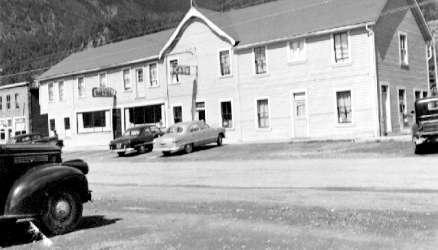 |
 |

|
|