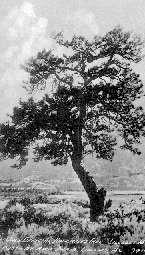
BC Archives # F-03512
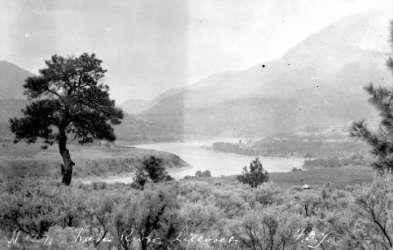
BC Archives # H-02884

Photo: Mike Cleven
| In support of my webspace rental fees pllease donate generously at GoFundMe or Patreon |
Thank your for visiting. If
you enjoy this site please make a donation. |
|
|
BC Archives # F-03512 |
BC Archives # H-02884 |
Photo: Mike Cleven |
| Lillooet's Hanging Tree is an unusually gnarled ponderosa pine on a benchland poised just above Main Street that enjoys a prime view of Lillooet's stunning canyon setting. According to local lore, twelve men - mostly Indians - were hung from the tree in the days of the Fraser Canyon gold rush, at least some of them by order of BC's famous "hanging judge" Sir Matthew Bailie Begbie. Some may have been victims of the Fraser Canyon War of the winter of 1858-9, when American miners slaughtered the majority of natives in the canyon towns, and concerning which Begbie's dairies mention him having to hang a few natives in Lillooet accused of stealing cattle in order to "keep the peace"; some may have only been common thieves hung by frontier justice, as there are no firm records of specific hangings. The main account of the Fraser Canyon War describes only events in the stretch from "The Forks" (Camchin, today's Lytton) to Yale; there are no written records of events in Lillooet during the hostilities. If any men were actually hung from this tree, the bodies were said to have been thrown into nearby rockpits that are tailings from Chinese mine washings of the same era. The Hanging Tree is a public park today, even though the tree has long since died, been torched, and been pruned post-mortem by chainsaw (to reduce the fire hazard). Its tortured limbs make it hauntingly unique among the other pines of its grove, many of which are likely grown from its own cones. The Hanging Tree remains a proud symbol of Lillooet's part in the opening of the "Wild West", as well as a reminder (if only a symbolic one) that it was judges and courts, and not armies, that were used to secure BC's place within "the rule of British law" (on the other hand, if Judge Begbie hung only a few from the tree, then the others might well have been lynchings). For anyone travelling to town, it's just above the Courthouse and Post Office and very close to Main Street but easy to miss if you didn't know about exactly where it is. The two pictures on the left are from the collection of the BC Provincial Archives, and date from times when the tree was still alive; the other picture is my own. Note in the middle picture that it was the sole tree on its bit of sage-covered benchland; the grove that stands around it today was planted in 1958 as part of the celebrations of the Centennial of the establishment of the Mainland Colony. | ||