The Cayoosh Gold Rush &
The Golden Cache Mine

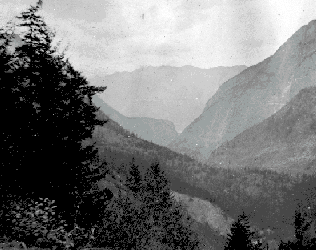
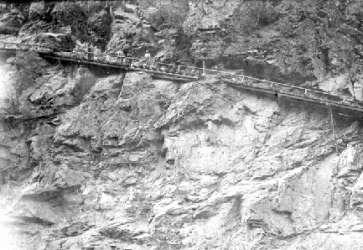
BC Archives # I-55188, Nkoomptch Gorge viewed from Cayoosh Canyon, 1897
BC Archives # I-55188   (Photo: Unknown, 1897)
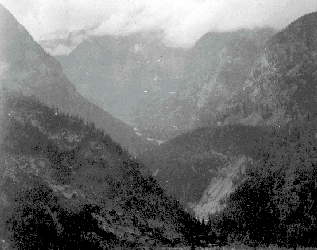
BC Archives # I-55187, Nkoomptch Gorge from Cayoosh Canyon, 1901
BC Archives # I-55187   (Photo: Unknown, 1901)
These very old pictures looking towards Lillooet from several miles up Cayoosh Canyon were possibly taken in connection with mining exploration and promotion connected with the Golden Cache Mine, which was the culmination of the Cayoosh Gold Rush of 1884-98, one of BC's lesser-known but nonetheless one of the richer of BC's many frontier gold rushes, and certainly among the  most spectacular physical settings, in the bottom of the huge gorge known in the old as "(the) Nkoomptch";here Seton, Cayoosh and Fraser watersheds come together, as do the ranges that frame them with stone walls well over a mile in a height.  The Golden Cache hardrock mine itself wound up as a "bust" - more money was lost by Vancouver investors than actual gold was found at this particular enterprise, but prior placer mining by Chinese miners working Cayoosh Creek from1884 onwards was estimated to have pulled out seven million dollars in gold nuggets in the several miles downstream from the site of where the Golden Cache hard-rock mine was located.  The hard-rock venture at the Golden Cache turned out to be nowhere near so profitable as what the Chinese had found in placer takings during their time on Cayoosh Creek; their claims spanned the banks of Cayoosh Creek from the Fraser up to a point six miles above Cayoosh Falls (now the private hydroelectric development at Walden North). As news of the secretive Chinese goldrush got out by the late 1880s, more and more non-Chinese showed up and, finding the main find fully staked, began to explore the region more carefully and more extensively than before.  This prompted the discovery of further mines along the Lakes and up in the Bridge River Country as well as closer to town on the lower Bridge River, nearer the Fraser, and on the bars around Lillooet itself.  


where the Chief of the Bridge River Band of the Lillooet, known today as 'Xwisten (hwistn, also the name of the river) sold extensive licenses for hydraulic mining up as far as Antoine Creek.  The claims along the Lakes played out, but the wider exploration of the Bridge River Country (as Lakes Chief Hunter Jack allowed) wound up finding a deep vein beneath the Bendor Range, which became Bralorne-Pioneer Mines.  Nearer Lillooet, except for the rich Chinese-owned claims, little was found by comparison to the Bridge River goldfields.  The Golden Cache itself, found by accident, did not produce anywhere near its expectations

The so-called Golden Cache Rush nonetheless attracted scores of non-Chinese prospectors and miners back from the by-then-depleted Cariboo goldfields who, for lack of available claims on Cayoosh Creek, wound up discovering further profitable claims along Seton and Anderson Lakes, ultimately leading to the discovery and development of the extremely rich Bridge River goldfields shortly afterwards.

During the original Fraser Canyon Gold Rush, the frenzy over the Fraser's many gold-bearing bars caused the nearby rocky streambeds of Cayoosh Creek to go unexplored in the haste for the easy gold of the Fraser's sands, and then the lure of the distant Cariboo fields much farther north.  Chinese miners returning from the Cariboo goldfields in the early 1880s found gold on the Cayoosh in the area of "the cataract", an old waterfall at the mouth of Cayoosh Canyon that now lies beneath the waters of the private hydroelectric development that is part of the Walden North estate.   Between there and about seven miles upstream the Chinese quietly staked out over 200 claims, with around 700 Chinese estimated to have been working their diggings for the next ten years.  The seven million dollars already mentioned is only an estimate by the local mining record, A.W.A. Phair, as unknown amounts of gold nuggets were believed to have been smuggled away from the digs before government assayers and the gold commissioner became aware of the extent of the find.  When news of the spectacular nugget beds spread elsewhere in the province, hundreds of non-Chinese miners converged on Lillooet only to discover that the main gold-bearing area of Cayoosh Creek was already fully-staked by the Chinese.  Nuggets on the Cayoosh ranged in value from one dollar to one hundred dollars in value; Cayoosh gold was all nuggets, in contrast to the Fraser's fine sands.  Many of the non-Chinese stayed on to re-work the Fraser's bars and to explore other parts of the region, some finding success, many not.  The Golden Cache was found in 1896 (above the upper end of the Chinese claims) as a result of this re-exploration of the Lillooet Country, and excited investors on the Vancouver markets lined up to back the new venture, causing a stockmarket boom and, finally, bust, as the Golden Cache hardrock turned out to be nowhere near as rich as the Cayoosh's streambeds downstream from it, which it seems to have been the motherlode for, albeit a depleted one.  The extreme engineering requirements of the Golden Cache's location high on the walls of Cayoosh Canyon no doubt contributed to its great expense and ensuing loss of investment.  The Chinese had by far the better part of the finds on Cayoosh Creek already by that time, but to be sure this involved digging the riverbed to 14 feet below the original streambed in order to find it all.  Still, placer mining is a far less expensive proposition than hard rock; only a major hard-rock find on the order of the Bralorne-Pioneer Mines could have made the Golden Cache profitable!  And unlike most, many of the Chinese miners stayed on in the Lillooet country in the following decades to found businesses as well as to develop a market-gardening industry for fruits and vegetables that were one of Lillooet's larger export markets for many years.  According to Mrs. Irene Edwards' history, "Short Portage to Lillooet", Lillooet's once-large Chinatown was mostly built in the Golden Cache period and in the years that followed.
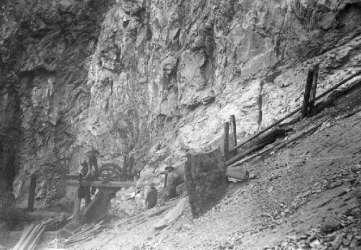
BC Archives # A-03545; Golden Cache Mine, Lillooet; View of Tramway with Ore Cars
BC Archives # A-03545
BC Archives # A-00373, Tramway at Golden Cache Mine, Cayoosh Canyon
BC Archives # A-00373
BC Archives # A-03549, Tramway at Golden Cache Mine, Cayoosh Canyon
BC Archives # A-03549
Please click on any of these  pictures to get the full-size version will you begin to appreciate the scale of technical adventure - and sheer bravado - that was the Golden Cache Mine.  Located high up on the sheer walls of Cayoosh Canyon, the Golden Cache was the final focus of a local gold rush in from 1884 to 1898 that was, of course, completely overshadowed by the much larger Klondike Gold Rush in the Yukon Territory.  In the picture at left, it is important to understand that the vein is up in the rockface and overhang, and that the tramway is built on a scaffolding against the cliff-face a couple of thousand feet above the raging waters of Cayoosh Creek far below.  Clicking on this image will produce a full-size version showing the scale of the tramway in relation to the cliffside (this is a close-up).  I have never been able to pinpoint the site of the mine on the wall of Cayoosh Canyon, which is directly opposite the new Duffey Lake Highway connecting Pemberton to Lillooet on one of the most spectacular stretches of paved highway in the province.   In recent years part of the rockface collapsed in a massive rockslide, but I do not know if this has eradicated the mine site or what remains of the old mill buildings depicted below.


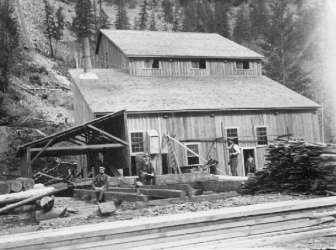
BC Archives # C-09848; Golden Cache Mine, Lillooet - Cyanide Mill on Cayoosh Creek
BC Archives # C-09848BC Archives # A-00374, Golden Cache Mine, Lumber Mill, Lillooet
BC Archives # A-00374
Both of these are described by their BC Archives captions as being mills at the Golden Cache Mine.  The BC Archives accredits the picture on the left as being the Golden Cache Mill, it looks more specifically like a lumber mill than a gold crusher; note the piles of timber; evidentlyly a special mill used to build the catwalks, gangways and tramways that distinguished the Golden Cache's unique cliffside tramway-stopes.  The building depicted at top fits what I know about the mine - that it lay across a long, narrow bridge above Cayoosh Creek and clung to the mountainside.  How the mill met with the terminus of the tramway I don't know.  The Golden Cache didn't last a decade (although it was very rich, producing around $6 million in 1898 dollars), but the excitement it generated brought in a new wave of gold prospectors into the Bridge River-Lillooet, the most important consequence of which was the discovery of the goldfields of the upper Bridge River, and the foundation of the Bralorne and Pioneer Mines.  Its fame was overshadowed by the greater glory of the Klondike Gold Rush in those same years, but as a result of the mine's boom the town and region of Lillooet boomed as they had not had since the original Gold Rush of 1858-9.  Renewed interest in the mineral and settlement potential of the region was reinspired by the Golden Cache boom, and helped set the stage for the Pacific Great Eastern Railway and other new development in the decades that followed.


Walden North

It is difficult to mention the Golden Cache Mine without mentioning the other great industrial undertaking on Cayoosh Creek - the estate known as Walden North.  In many ways Walden North was even more of a pioneering effort than the Golden Cache, despite the fact that it was developed only in the 1960s and '70s; perhaps it might be considered the most significant industrial undertaking in the whole history of the Bridge River Country, even though it remains largely unknown today and was pretty well top-secret for most of its existence until its founder passed away and the estate was sold.  A private undertaking by Vernon Pick, a retired and extraordinarily wealthy prospector from the US, Walden North was one of two estates in North America chosen for their location in relation to rainfall patterns and freshwater availability.  Legend has it that Mr. Pick had made his money in some of the first large uranium discoveries sold to the United States before the war and he had a complex about the dangesr of impending nuclear war; his estates were designed to be apocalypse-proof; Cayoosh Canyon turns out to be one of the more radiation-proof gulches in the whole of North America; the other location is somewhere in Arizona.

There are many stories about Walden North; that it has room for hundreds of scientists and others in the event of war or social collapse; that its self-contained hydroelectric plant supports not only the "bunker" sections of the complex, but also in their time helped power high-tech manufacturing plants.  One of Walden North's main products were photocopier drums; another product were microchip components.  Vernon Pick also had an interest in antique furniture and had a workshop devoted to making good-quality reproductions.   Supposedly Pick had interests in particle physics, and one of the wilder legends about Walden North was that he had his own particle accelerator in some chamber deep within the mountain, along with other fabulous laboratories.  Some of this may be hearsay, but some I've had told to me by people who worked for Pick, so I can't discount it that easily.

A mysterious figure, Pick never had close relations with the local government or business communities and upon his death in the late 1980s, the estate passed into the hands of other owners, with technical equipment of all kinds being sold off at auction.  I've met people who've heard of Lillooet just for that reason - the range and content of the Pick auction menu.  Certainly one of the most colourful - if least known - of the citizenry of the Lillooet country over the years, Pick's career serves to show that even a remote location like Lillooet can be an exporter of technical products - as well as an excellent location for ridiculously wealth zillionaires to build fancy estates in . . . .


Nature Studies
BC Scenery & History
Chinook Jargon
Clevens & Periards
Poetry etc.
e-mail me! (replace "_at_" in address with @ symbol)