Chinook Jargon Phrasebook
Kahta Mamook Kopa Chinook Wawa - How to speak Chinook
Kamloops Wawa Word List:
This is a list of basic Chinook Jargon words as
reproduced in Kamloops Wawa, a publication of the Oblate missionary
community in
British Columbia during the 1890s. This is not, as far as I can
tell, the same list as one in another edition of Kamloops Wawa, as
there
are some differences in spelling that I remember from the other
version.
This list is produced separately here from the rest of the Phrasebook
because
of the wide divergence in spelling and apparent prononciation from the
other versions of the lexicon, most of which were published in the
United
States. There are also some words included here which do not
appear
in the usual sources (Gibbs, Shaw, etc.).
The original version of this list as it appeared in
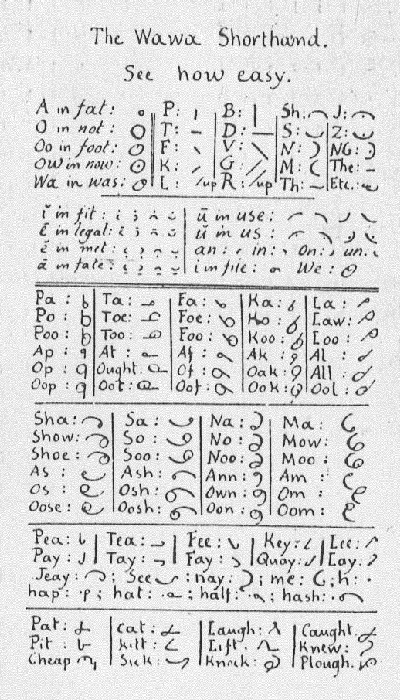
Kamloops Wawa included renderings of the words given in the Duployan
shorthand
script developed for the Jargon by Fr. Lejeune; there were apparently
at one time over 2000 people fluent in reading the Jargon in this
shorthand,
and many copies of the Kamloops Wawa are nearly entirely in the
shorthand
alone. The texts
in yellow are my own additions, consisting of the usual (or
alternate) spellings of the Jargon words noted, plus comments about
their
usual meanings and possible contexts; when necessary I have added links
to appropriate pages elsewhere in this site that are pertinent to the
word
cited. At the bottom of the word list there is some
editorializing
concerning the Jargon and the Duployan shorthand that was included in
the
same issue of the Kamloops Wawa as the word list, and for your
convenience
in studying the Duployan script glyphs of each word, the table of forms and
associated
phonemes may be viewed by clicking here (144kb). A
later revision of this page will attempt to align the glyphs according
to the baseline used in the original, which is too large of a GIF to be
viewed here in any legible format; many of the angle-lines shown here
are below this baseline.
NB: concerning prononciation, the final
"-e"
and "-ale" on most words should be understood to be a pronounced
syllable,
rather than a modifier of the preceding vowel as it is in
English.
e.g. the word poolale here is usually given in other Jargon
lexicons
as pollalie.
Current alphabetization is based on the spellings
as transliterated by LeJeune. Later improvements to these pages
will cross-reference the Kamloops Wawa spellings with the more common
Gibbs/Shaw system, and perhaps the new phonologically-strict
orthography of the Grand Ronde Creole. Note that some words are
placed alphabetically; e.g. "ice" is under 'A" because of the opening
vowel, unlike other i-words which have "ih" at the start.
Similarly, whip and wheat are in 'h" because LeJeune transcribed them
with the whispered-h pronuncation once proper in English..
S
 Sahale
- Above saghalie, sagalie also means over, high up, the sky. In
use by missionaries it was coopted to mean heaven, and became
confused with the meaning holy or sacred because of its
use for God - Saghalie Tyee, i.e. chief above
Sahale
- Above saghalie, sagalie also means over, high up, the sky. In
use by missionaries it was coopted to mean heaven, and became
confused with the meaning holy or sacred because of its
use for God - Saghalie Tyee, i.e. chief above
 Saia - Far siah
in Nookta/Nuu-chah-nulth
territory this word meant sky
Saia - Far siah
in Nookta/Nuu-chah-nulth
territory this word meant sky
 Saplel
- Bread sapollil also means flour, wheat, etc. Bread
can also be lepan
Saplel
- Bread sapollil also means flour, wheat, etc. Bread
can also be lepan
 Sakalooks
- Pants sakolleks trousers, etc.
Sakalooks
- Pants sakolleks trousers, etc.
 Salix - Angry solleks
 Siahus
- Eyes seeahost, siaghost also means the face, etc.
Siahus
- Eyes seeahost, siaghost also means the face, etc.
 Siesem - Tell this appears to be related to yiem, which was
used for the same meaning in Puget Sound and the Lower Columbia, and
could also mean a tale or a story
Siesem - Tell this appears to be related to yiem, which was
used for the same meaning in Puget Sound and the Lower Columbia, and
could also mean a tale or a story
 Sitkom - Half sitkum also means halfway, part of
 Sele
- Soul does not appear
in other lexicons; appears to be a borrowing from the German seele;
this term may have been introduced by the Oblates because the French
loanword equivalent would have been lahm (from l'ame),
which is the
same as the word for oar
Sele
- Soul does not appear
in other lexicons; appears to be a borrowing from the German seele;
this term may have been introduced by the Oblates because the French
loanword equivalent would have been lahm (from l'ame),
which is the
same as the word for oar
 Senmoxt - Seven sinamoxt
 Stiwil - Pray does not appear in other lexicons; appears to be a
borrowing from Secwepemc (Shuswap)
Stiwil - Pray does not appear in other lexicons; appears to be a
borrowing from Secwepemc (Shuswap)
 Stalo - River does not appear in other lexicons, where liver
or chuck is generally provided for river; appears to be
a borrowing from the Salishan languages of the Fraser-Thompson
basin. The First Nation of the lower canyon and upper delta of
the Fraser River goes by
the name Sto:lo (the ":" being a sort of glottal stop)
Stalo - River does not appear in other lexicons, where liver
or chuck is generally provided for river; appears to be
a borrowing from the Salishan languages of the Fraser-Thompson
basin. The First Nation of the lower canyon and upper delta of
the Fraser River goes by
the name Sto:lo (the ":" being a sort of glottal stop)
 Skookum - Strong also means big,
true,
able, genuine, powerful
Skookum - Strong also means big,
true,
able, genuine, powerful
 Snaz - Rain snass
 Sail
Sail
 Sell
Sell
 Sky
Sky
 Stick Used in the broad general sense
of wood; trees, shipmasts, and building
lumber alike were all called stick, with or without modifying
adjectives.
Stick Used in the broad general sense
of wood; trees, shipmasts, and building
lumber alike were all called stick, with or without modifying
adjectives.
 Day While the word
depicted here by thy glyph is indeed an
English word, it is not day, but rather the word that was used
to
mean day - sun.
Day While the word
depicted here by thy glyph is indeed an
English word, it is not day, but rather the word that was used
to
mean day - sun.
 Snow
Snow
Re: Words borrowed from English
It should be explained here that not all the words in
the following list necessarily have the same meanings they customarily
do in English - "wind", for example can refer to weather of all kinds
depending on what adjective is used with it; it also refers to breath,
to breathe, and to be alive iskum wind or mitlite wind.
Also the script characters given, when deciphered, are a demonstration
that the prononciation of these words was different than in English -
"old" and "cold" being pronounced "ole" and "cole", and "warm" being
pronounced "waum". Please refer to the
shorthand table reproduced here from Kamloops Wawa if you care to
decipher any of the following pronounciations yourself.
E-mail
Bridge River-Lillooet Country | BC History & Scenery
|
Chinook Jargon Main Page | Clevens & Periards | Poetry