Chinook Jargon Phrasebook
Kahta Mamook Kopa Chinook Wawa - How to speak Chinook
Kamloops Wawa Word List:
This is a list of basic Chinook Jargon words as
reproduced in Kamloops Wawa, a publication of the Oblate missionary
community in
British Columbia during the 1890s. This is not, as far as I can
tell, the same list as one in another edition of Kamloops Wawa, as
there
are some differences in spelling that I remember from the other
version.
This list is produced separately here from the rest of the Phrasebook
because
of the wide divergence in spelling and apparent prononciation from the
other versions of the lexicon, most of which were published in the
United
States. There are also some words included here which do not
appear
in the usual sources (Gibbs, Shaw, etc.).
The original version of this list as it appeared in
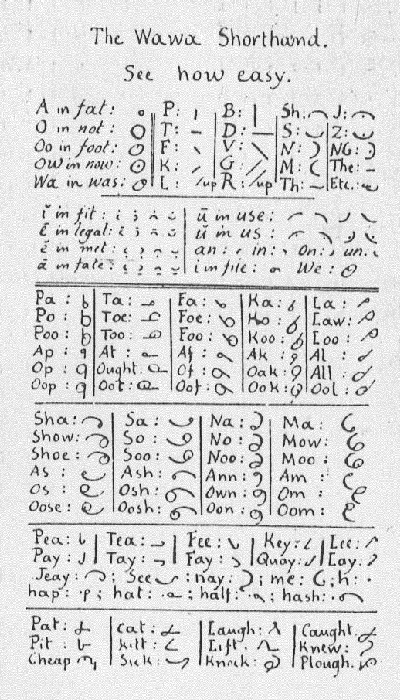
Kamloops Wawa included renderings of the words given in the Duployan
shorthand
script developed for the Jargon by Fr. Lejeune; there were apparently
at one time over 2000 people fluent in reading the Jargon in this
shorthand,
and many copies of the Kamloops Wawa are nearly entirely in the
shorthand
alone. The texts
in yellow are my own additions, consisting of the usual (or
alternate) spellings of the Jargon words noted, plus comments about
their
usual meanings and possible contexts; when necessary I have added links
to appropriate pages elsewhere in this site that are pertinent to the
word
cited. At the bottom of the word list there is some
editorializing
concerning the Jargon and the Duployan shorthand that was included in
the
same issue of the Kamloops Wawa as the word list, and for your
convenience
in studying the Duployan script glyphs of each word, the table of forms and
associated
phonemes may be viewed by clicking here (144kb). A
later revision of this page will attempt to align the glyphs according
to the baseline used in the original, which is too large of a GIF to be
viewed here in any legible format; many of the angle-lines shown here
are below this baseline.
NB: concerning prononciation, the final
"-e"
and "-ale" on most words should be understood to be a pronounced
syllable,
rather than a modifier of the preceding vowel as it is in
English.
e.g. the word poolale here is usually given in other Jargon
lexicons
as pollalie.
Current alphabetization is based on the spellings
as transliterated by LeJeune. Later improvements to these pages
will cross-reference the Kamloops Wawa spellings with the more common
Gibbs/Shaw system, and perhaps the new phonologically-strict
orthography of the Grand Ronde Creole. Note that some words are
placed alphabetically; e.g. "ice" is under 'A" because of the opening
vowel, unlike other i-words which have "ih" at the start.
Similarly, whip and wheat are in 'h" because LeJeune transcribed them
with the whispered-h pronuncation once proper in English..
L
 Lolo
- Carry can also mean a burden, a load, to portage
Lolo
- Carry can also mean a burden, a load, to portage
 Laket - Four lakit
 Lele
- A long time laly this seems to more have been an
auxiliary for measures of time; in combination with ahnkuttie,
the
word for the past, it means "a really long time ago" or antiquity,
while in combination with words for the future (winapie, alki,
etc.) it actually meant "soon", "not long now", rather
than "a long time from now"
Lele
- A long time laly this seems to more have been an
auxiliary for measures of time; in combination with ahnkuttie,
the
word for the past, it means "a really long time ago" or antiquity,
while in combination with words for the future (winapie, alki,
etc.) it actually meant "soon", "not long now", rather
than "a long time from now"
 Light
Light
 Life
Life
 Law
Law
 Leaves
 Lake
Lake
 Lazy
Lazy
 Rope
Examination
of the glyph here will show the usual Jargon prononciation of this
loanword - lope. Similar R-Ll transitions can be found
throughout this word list.
Rope
Examination
of the glyph here will show the usual Jargon prononciation of this
loanword - lope. Similar R-Ll transitions can be found
throughout this word list.
M
 Maika - Thou mika
i.e. the second person singular;
as with all pronouns, can also be the accusative or genitive/possessive
(i.e. thee, thine)
Maika - Thou mika
i.e. the second person singular;
as with all pronouns, can also be the accusative or genitive/possessive
(i.e. thee, thine)
 Makmak - Eat muckamuck generally means to
ingest, including to drink; can also be used for food,
dinner or
a meal
Makmak - Eat muckamuck generally means to
ingest, including to drink; can also be used for food,
dinner or
a meal
 Mamook
- Work also means to do, to make, etc.; used to form
verbs by combination with nouns and adjectives, and to form the passive
or imperative in combination with other verbs and adverbs
Mamook
- Work also means to do, to make, etc.; used to form
verbs by combination with nouns and adjectives, and to form the passive
or imperative in combination with other verbs and adverbs
 Makook - Buy mahkook can also mean to trade,
to shop, to do business, etc., and can also mean to sell,
though not as commonly
Makook - Buy mahkook can also mean to trade,
to shop, to do business, etc., and can also mean to sell,
though not as commonly
 Mowich
- Deer mowitch
can refer to animals in general
Mowich
- Deer mowitch
can refer to animals in general
 Mash - Throw mahsh
has a wide variety of meanings and possible contexts
Mash - Throw mahsh
has a wide variety of meanings and possible contexts
 Masachi
- Bad mesachie has the specific context/connotation of malice
or evil, whereas kaltash (cultus)
and tamanwaz (tamanass, tamahnous) have other less
explicitly
malign meanings
Masachi
- Bad mesachie has the specific context/connotation of malice
or evil, whereas kaltash (cultus)
and tamanwaz (tamanass, tamahnous) have other less
explicitly
malign meanings
 Moxt - Two mokst
 Moosum
- Sleep
Moosum
- Sleep
 Moosmoos - Beef also means cattle, cow, etc. Not to be
confused with moose, which was either used as a loanword itself
or was given as hyas mowitch (which could also mean elk)
Moosmoos - Beef also means cattle, cow, etc. Not to be
confused with moose, which was either used as a loanword itself
or was given as hyas mowitch (which could also mean elk)
 Mitlait - Remain mitlite has a wide variety of meanings and possible
contexts
Mitlait - Remain mitlite has a wide variety of meanings and possible
contexts
 Mitooit - Stand mitwhit also means upright, standing up,
etc.
Mitooit - Stand mitwhit also means upright, standing up,
etc.
 Memloos - Dead memaloose,
mimaloose also
means death, to kill, to die
Memloos - Dead memaloose,
mimaloose also
means death, to kill, to die
 Msaika
- You mesika, mesaika
the plural second person; as
with all pronouns, can also be the genitive/possessive (i.e. yours)
Msaika
- You mesika, mesaika
the plural second person; as
with all pronouns, can also be the genitive/possessive (i.e. yours)
 Man
Man
N
 Naika - I,
me nika as with all pronouns, can also be the
genitive/possessive (i.e. mine)
Naika - I,
me nika as with all pronouns, can also be the
genitive/possessive (i.e. mine)
 Nawitka
- Yes nowitka was commonly used for "indeed!", i.e.
an emphatic imperative
Nawitka
- Yes nowitka was commonly used for "indeed!", i.e.
an emphatic imperative
 Nanich
- See nanitch also used to mean to look, to watch,
sight, vision, etc. The phrase kloshe nanitch - watch
well, i.e. to guard, to look out - was the motto of the
Kamloops-based militia regiment the Rocky Mountain Rangers.
Nanich
- See nanitch also used to mean to look, to watch,
sight, vision, etc. The phrase kloshe nanitch - watch
well, i.e. to guard, to look out - was the motto of the
Kamloops-based militia regiment the Rocky Mountain Rangers.
 Nsaika - We nesika,
nesaika the
plural first person; can also be the accusative and genitive/possessive
(i.e.
us, ours)
Nsaika - We nesika,
nesaika the
plural first person; can also be the accusative and genitive/possessive
(i.e.
us, ours)
Re: Words borrowed from English
It should be explained here that not all the words in
the following list necessarily have the same meanings they customarily
do in English - "wind", for example can refer to weather of all kinds
depending on what adjective is used with it; it also refers to breath,
to breathe, and to be alive iskum wind or mitlite wind.
Also the script characters given, when deciphered, are a demonstration
that the prononciation of these words was different than in English -
"old" and "cold" being pronounced "ole" and "cole", and "warm" being
pronounced "waum". Please refer to the
shorthand table reproduced here from Kamloops Wawa if you care to
decipher any of the following pronounciations yourself.
E-mail
Bridge River-Lillooet Country | BC History & Scenery
|
Chinook Jargon Main Page | Clevens & Periards | Poetry