 Get up
  Grease
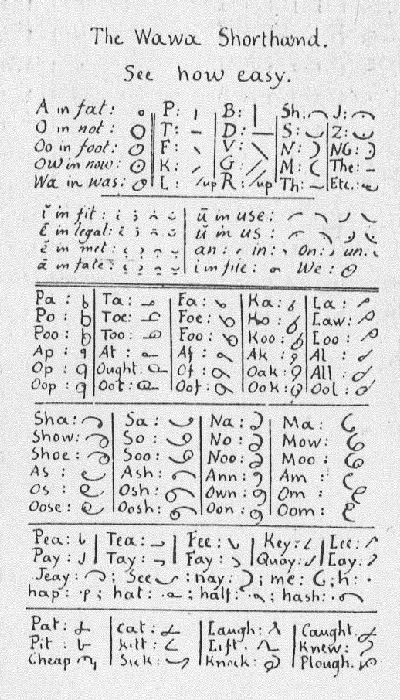
 The original version of this list as it appeared in Kamloops Wawa included renderings of the words given in the Duployan shorthand script developed for the Jargon by Fr. Lejeune; there were apparently at one time over 2000 people fluent in reading the Jargon in this shorthand, and many copies of the Kamloops Wawa are nearly entirely in the shorthand alone. The texts in yellow are my own additions, consisting of the usual (or alternate) spellings of the Jargon words noted, plus comments about their usual meanings and possible contexts; when necessary I have added links to appropriate pages elsewhere in this site that are pertinent to the word cited. At the bottom of the word list there is some editorializing concerning the Jargon and the Duployan shorthand that was included in the same issue of the Kamloops Wawa as the word list, and for your convenience in studying the Duployan script glyphs of each word, the table of forms and associated phonemes may be viewed by clicking here (144kb). A later revision of this page will attempt to align the glyphs according to the baseline used in the original, which is too large of a GIF to be viewed here in any legible format; many of the angle-lines shown here are below this baseline.
NB: concerning prononciation, the final
"-e"
and "-ale" on most words should be understood to be a pronounced
syllable,
rather than a modifier of the preceding vowel as it is in
English.
e.g. the word poolale here is usually given in other Jargon
lexicons
as pollalie.
Current alphabetization is based on the spellings
as transliterated by LeJeune. Later improvements to these pages
will cross-reference the Kamloops Wawa spellings with the more common
Gibbs/Shaw system, and perhaps the new phonologically-strict
orthography of the Grand Ronde Creole. Note that some words are
placed alphabetically; e.g. "ice" is under 'A" because of the opening
vowel, unlike other i-words which have "ih" at the start.
Similarly, whip and wheat are in 'h" because LeJeune transcribed them
with the whispered-h pronuncation once proper in English..
Get up
Grease
(includes hard-c words, e.g.
"coat"0
 Kah? - Where? Generic interrogative, can also be conjunctive and
prepositional, and can mean what, etc. and the conjunctive form
of that, which, etc.
Kah? - Where? Generic interrogative, can also be conjunctive and
prepositional, and can mean what, etc. and the conjunctive form
of that, which, etc.
 Kapshwala
- Steal kapswalla can also mean stealthy, illicit,
crooked, etc., e.g. klatawa kapswalla - to go
cautiously, to travel secretly
Kapshwala
- Steal kapswalla can also mean stealthy, illicit,
crooked, etc., e.g. klatawa kapswalla - to go
cautiously, to travel secretly
 Kata - How? kahta? also means why
 Kakwa - Thus kahkwa also used for how, like, as, as if, similar to
 Kakshet - Broken kokshut also means a blow, a strike, smashed
to pieces
Kakshet - Broken kokshut also means a blow, a strike, smashed
to pieces
 Kalakala - Birds
 Kaltash - Useless cultus also meant ordinary, broken, meaningless, shiftless
and was often used to mean bad, ill although it also had quite
neutral meanings, i.e. cultus potlatch, a simple gift (i.e.
one without conditions)
Kaltash - Useless cultus also meant ordinary, broken, meaningless, shiftless
and was often used to mean bad, ill although it also had quite
neutral meanings, i.e. cultus potlatch, a simple gift (i.e.
one without conditions)
 Kanawe
- All konoway, konaway
the compound kopa konaway
was used for
the whole way, the whole shebang, everything and then some, etc.
Kanawe
- All konoway, konaway
the compound kopa konaway
was used for
the whole way, the whole shebang, everything and then some, etc.
 Kanamoxt
- together kunamoxt, kunamokst also used to mean both, the two, a pair;
seems to have its origin as konaway moxt - all two
Kanamoxt
- together kunamoxt, kunamokst also used to mean both, the two, a pair;
seems to have its origin as konaway moxt - all two
 Kansih?
- How many? kunjih? kunsih? was used for any question relating to
quantity, including how much? as in a price
Kansih?
- How many? kunjih? kunsih? was used for any question relating to
quantity, including how much? as in a price
 Kamooks
- Dog
Kamooks
- Dog
 Kopa - at, in generic preposition;
can also mean to, with, by, by means of, etc.
Kopa - at, in generic preposition;
can also mean to, with, by, by means of, etc.
 Kopet
- Done
Also means to finish, to
stop, to complete, and
but for, even, still, yet, etc.
Kopet
- Done
Also means to finish, to
stop, to complete, and
but for, even, still, yet, etc.
 Kolan
- Ear kwolann,
kwolan also
means to hear, to listen, esp. in combination with mamook
Kolan
- Ear kwolann,
kwolan also
means to hear, to listen, esp. in combination with mamook
 Komtax - Know kumtux,
kumtuks also
means to understand, to think, etc.
Komtax - Know kumtux,
kumtuks also
means to understand, to think, etc.
 Kwaten - Belly kwahtin, yakwahtin also means the stomach, the torso, the
trunk of the body, the entrails, etc.
Kwaten - Belly kwahtin, yakwahtin also means the stomach, the torso, the
trunk of the body, the entrails, etc.
 Kwash
- Afraid kwass
Kwash
- Afraid kwass
 Kwanesem - Always kwanesum, kwonesum
also means forever, eternity,
eternal
Kwanesem - Always kwanesum, kwonesum
also means forever, eternity,
eternal
 Kwenam - Five kwinnum
 Quarter i.e. "Kwatah"
 Kiss
Kiss
 Kipooit
- to sew kipwit, kipwot, keepwot can also mean a needle or
an awl
Kipooit
- to sew kipwit, kipwot, keepwot can also mean a needle or
an awl
 Kikoole - Below keekwullee,
kickwillie also
means underground, beneath, an underground house, etc.
Kikoole - Below keekwullee,
kickwillie also
means underground, beneath, an underground house, etc.
 Kilapai
- Upset kilapi,
killapie upset
as in turned over, etc.; also means changed, reversed, to
go back, etc.
Kilapai
- Upset kilapi,
killapie upset
as in turned over, etc.; also means changed, reversed, to
go back, etc.
 Kimta
- Behind kimtah also means after,
following, next, etc.; can mean later on
Kimta
- Behind kimtah also means after,
following, next, etc.; can mean later on
 Kiskis - to drive kishkish
 Kiutan - Horse kiuatan It surprised me to see this in the
Kamloops-area word list, as the word cayoosh was common in the
Jargon of the BC Interior to mean horse, specifically a
mountain-pony
Kiutan - Horse kiuatan It surprised me to see this in the
Kamloops-area word list, as the word cayoosh was common in the
Jargon of the BC Interior to mean horse, specifically a
mountain-pony
 Klahane - Outside klahanie the
outdoors in general, as well as outside of a building or in
the open
Klahane - Outside klahanie the
outdoors in general, as well as outside of a building or in
the open
 Klahoyam - Poor klahowyum, klahowya
also means miserable, etc.;
used as the main greeting in the jargon (perhaps originally ironically)
Klahoyam - Poor klahowyum, klahowya
also means miserable, etc.;
used as the main greeting in the jargon (perhaps originally ironically)
 Klatwa
- Go klatawa, klattawah also means to move, to travel, etc.
Klatwa
- Go klatawa, klattawah also means to move, to travel, etc.
 Klaksta
- Who
Klaksta
- Who
 Klaska - They as with all pronouns, also used for the accusative and
genitive/possessive (i.e. them, theirs)
Klaska - They as with all pronouns, also used for the accusative and
genitive/possessive (i.e. them, theirs)
 Kliskes
- mats
kliskwis, klisskwiss
Kliskes
- mats
kliskwis, klisskwiss
 Klootchmin
- Woman klootchman
also used in compounds to
indicate the female of any species; in later times its use in
application
to humans was restricted to native women
Klootchmin
- Woman klootchman
also used in compounds to
indicate the female of any species; in later times its use in
application
to humans was restricted to native women
 Kloonas - Possibly klonas maybe, perhaps
 Knim
- Canoe canim
Knim
- Canoe canim
 Kho - Reach ko i.e. to arrive at
 Khow - Tie kow specifically in the combination mamook
kow; kow by itself seems to mean a knot or
tied-up
Khow - Tie kow specifically in the combination mamook
kow; kow by itself seems to mean a knot or
tied-up
 Khell - Hard kull means physically hard, as in texture, as well
as a term for difficulty
Khell - Hard kull means physically hard, as in texture, as well
as a term for difficulty
 Kapho - Brother kahpo the elder brother, a
person older than the speaker
Kapho - Brother kahpo the elder brother, a
person older than the speaker
 Coat
Coat
 Kettle
 Chako - Come used for to become,
and for certain passive compounds; has a wide variety of other meanings
and contexts in various
compounds
Chako - Come used for to become,
and for certain passive compounds; has a wide variety of other meanings
and contexts in various
compounds
 Chok - Water chuck fluids in general, lakes,
water, sea, etc. "out on the chuck" remains an expression in
English of the region for being out on a boat
Chok - Water chuck fluids in general, lakes,
water, sea, etc. "out on the chuck" remains an expression in
English of the region for being out on a boat
 Che - New chee
also means recently, newly come, etc.
Che - New chee
also means recently, newly come, etc.
 Chikmin - Metal chickamin,
chikamin specifically
iron; with adjectives for colour can mean gold or silver
(i.e. pil and tkope, respectively). Also means
money
Chikmin - Metal chickamin,
chikamin specifically
iron; with adjectives for colour can mean gold or silver
(i.e. pil and tkope, respectively). Also means
money