 Basket
  Boat
Boat  Boot
Boot  Bed
Bed  Bone
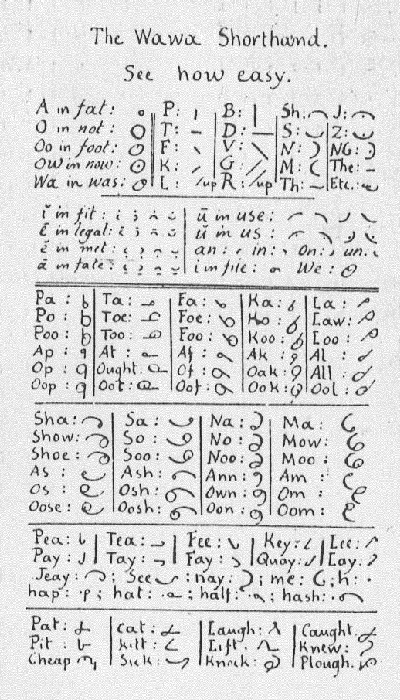
Bone The original version of this list as it appeared in Kamloops Wawa included renderings of the words given in the Duployan shorthand script developed for the Jargon by Fr. Lejeune; there were apparently at one time over 2000 people fluent in reading the Jargon in this shorthand, and many copies of the Kamloops Wawa are nearly entirely in the shorthand alone. The texts in yellow are my own additions, consisting of the usual (or alternate) spellings of the Jargon words noted, plus comments about their usual meanings and possible contexts; when necessary I have added links to appropriate pages elsewhere in this site that are pertinent to the word cited. At the bottom of the word list there is some editorializing concerning the Jargon and the Duployan shorthand that was included in the same issue of the Kamloops Wawa as the word list, and for your convenience in studying the Duployan script glyphs of each word, the table of forms and associated phonemes may be viewed by clicking here (144kb). A later revision of this page will attempt to align the glyphs according to the baseline used in the original, which is too large of a GIF to be viewed here in any legible format; many of the angle-lines shown here are below this baseline.
NB: concerning prononciation, the final
"-e"
and "-ale" on most words should be understood to be a pronounced
syllable,
rather than a modifier of the preceding vowel as it is in
English.
e.g. the word poolale here is usually given in other Jargon
lexicons
as pollalie.
Current alphabetization is based on the spellings
as transliterated by LeJeune. Later improvements to these pages
will cross-reference the Kamloops Wawa spellings with the more common
Gibbs/Shaw system, and perhaps the new phonologically-strict
orthography of the Grand Ronde Creole. Note that some words are
placed alphabetically; e.g. "ice" is under 'A" because of the opening
vowel, unlike other i-words which have "ih" at the start.
Similarly, whip and wheat are in 'h" because LeJeune transcribed them
with the whispered-h pronuncation once proper in English..
Basket
Boat
Boot
Bed
Bone
 Fight
Fight
 Fish
Fish
 Fly
Fly
 Flowers
 Paia
- Fire piah also means hot, cooked, ripe
Paia
- Fire piah also means hot, cooked, ripe
 Pasisi
- Blankets paseese can also mean cloth in general
Pasisi
- Blankets paseese can also mean cloth in general
 Patl - Full pahtl
 Patlach - Give potlatch
this word also means a gift,
and was used to describe the institution of the gift-feast. NB cultus
potlatch - "just a gift", i.e. a way of downplaying the gift
or act of giving as in humility
Patlach - Give potlatch
this word also means a gift,
and was used to describe the institution of the gift-feast. NB cultus
potlatch - "just a gift", i.e. a way of downplaying the gift
or act of giving as in humility
 Poo - Shot i.e. a shot
(of gunfire), or the shot-pellet or a bullet
Poo - Shot i.e. a shot
(of gunfire), or the shot-pellet or a bullet
 Poolakle - Night polaklie also means darkness, evening, shadow, etc.
 Poolale - Powder pollalie
 Poos - If does not occur in other lexicons; may be a borrowing
from the French puis
Poos - If does not occur in other lexicons; may be a borrowing
from the French puis
 Pi - And pe also means but, and in other areas if
 Pel - Red pil
 Pelpel - Blood pil-pil, pilpil
 Pelten
- Insane
pelton can
also mean a fool, deranged, foolish etc. I do not think
this was associated with violent
insanity, but rather with harmless befuddlement or mental incapacitation
Pelten
- Insane
pelton can
also mean a fool, deranged, foolish etc. I do not think
this was associated with violent
insanity, but rather with harmless befuddlement or mental incapacitation
 Papa - father
 Papoose - baby, specifically Indian baby
 Play
Play
 Pipe
Pipe
 Pin
Pin